

A long list of properties can leave a client with the same unanswered question: which of these is worth pursuing? Research should explain which options fit the brief, what is missing and what needs checking before the client proceeds.
The brief needs a question that can be investigated. A business choosing premises, an owner considering a different occupier and a developer comparing land will need different information, even when they are looking in the same area.
The brief determines what is worth researching
“Which buildings could accommodate this operation?” gives a search a purpose. The answer depends on the space, access, location and timing the business needs. Essential requirements should be distinguishable from preferences that can change. Use the premises search brief builder to record both before comparing properties.
For an owner, the question might be which uses merit investigation for a vacant building. Its dimensions, occupation and available records matter to that judgement. A list of businesses seeking premises becomes more useful when their requirements can be compared with the actual property.
A location study needs a defined area and a reason for examining it. Nearby alternatives can be included, provided the report makes their position clear. Otherwise, a wider search can quietly change what the findings describe.
The brief should also identify the decision-maker and deadline. That helps establish how much investigation is worthwhile before the next decision, and which questions need a specialist’s opinion.
A shortlist needs a common basis for comparison
Two properties can appear similarly priced while offering different occupation arrangements. A monthly charge for serviced space may include items excluded from an annual headline rent. The comparison needs to show the basis, period and inclusions of each figure. The premises cost comparison lets you put rent, regular outgoings and upfront cash beside each other using your own figures.
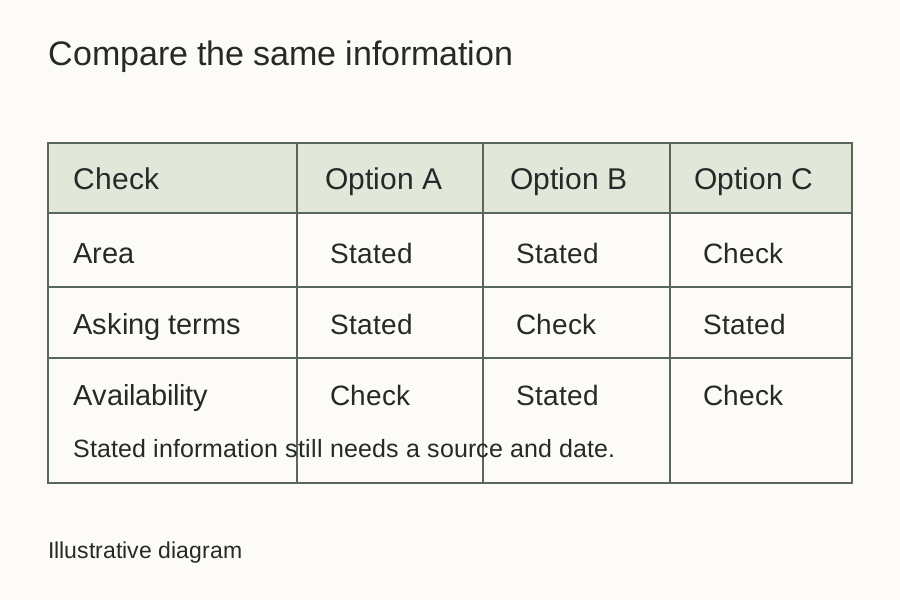
Asking terms should remain labelled as asking terms. An omitted cost belongs among the unanswered questions. It should not disappear into an assumed total that makes the options look more comparable than they are.
The same care applies to area, tenure, access and availability. A building may meet the space requirement but become available too late. Another may fit the timetable while depending on an unconfirmed alteration. Those differences belong beside the property facts.
Sources make the findings traceable. Property particulars, direct responses and public records each contribute information, with a date and relevant reference. In England and Wales, HM Land Registry records can help establish registered ownership and title information; title plans generally show boundaries rather than their exact line.
For an England site, planning records and guidance and the flood map for planning may inform the investigation. Their interpretation and any site-specific work need to be identified separately.
Availability is another dated finding. An older listing can identify a lead, while a current owner or agent response helps establish whether there is a property to pursue and on what conditions.
Show what remains unknown
The most useful missing answer is the one that could change the shortlist. Unmeasured height can prevent an assessment of a sports use. Unconfirmed access rights can affect a land purchase. A service upgrade can alter the occupation timetable.
A report should explain the consequence of each material gap and identify who can resolve it. That may involve an owner response, a measured survey, a site visit or a legal or planning opinion. The client can then decide which next step is worth funding.
The conclusion needs to return to the original question. It should explain which options merit further work, why they remain under consideration and what assumptions support that view. A small sample of listings cannot establish an entire market’s behaviour.
Rejected options can remain useful too. A property ruled out by timing may become relevant later; one rejected for an essential physical constraint may remain unsuitable. Keeping the reason avoids repeating the investigation without a change in circumstances.
If you need premises or land to buy or lease, our commercial property search and acquisition service covers finding options and contacting owners or agents.
Rivermark researches properties and locations against an agreed question. The report should explain which options merit further investigation and what each investigation needs to establish.